
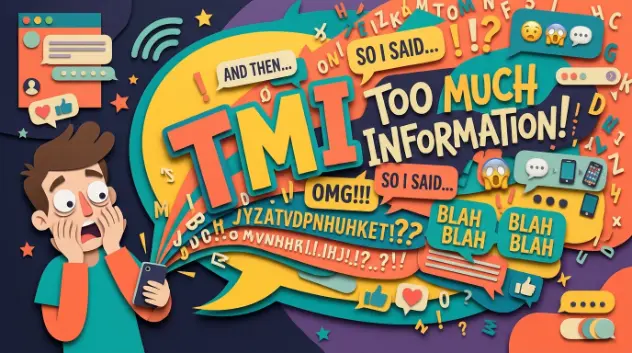
TMI means “Too Much Information” in text messages, online chats, and social media. People use it when someone shares more details than necessary, especially information that is personal, embarrassing, graphic, or uncomfortable to hear. It can also describe a message that contains more detail than the reader wants.
For example:
- Friend 1: “I had a stomach problem all night, and I won’t describe the rest.”
- Friend 2: “TMI 😂”
In this conversation, TMI is a casual way to say that the details are more than the other person wants to hear. The laughing emoji suggests a playful reaction rather than serious criticism.
When someone sends you “TMI,” they might be joking, expressing discomfort, or politely asking you to stop sharing personal details. The exact meaning depends on the conversation, your relationship, and the tone of the message.
What Does TMI Meaning in Text Stand for?
TMI stands for Too Much Information. It is an informal abbreviation used in everyday conversation, texting, online messaging, and social media. Major English dictionaries recognize this meaning.
Although people often associate TMI with embarrassing or private subjects, it is not limited to those situations. Someone might use it when a friend explains a story in unnecessary detail or gives a long answer to a simple question.
For example:
Person A: “The movie starts at 7, but first I need to tell you what happened when I bought the tickets, where I parked, and what the cashier said.”
Person B: “TMI! Just tell me when to meet you.”
Here, TMI refers to excessive detail rather than anything inappropriate.
In short, TMI communicates one basic idea: the information being shared is more than the listener or reader needs or wants.
What Does TMI Meaning in Text Message?
In texting, TMI is usually a quick reaction to something the sender considers too personal, too detailed, or unnecessary. Instead of typing “I didn’t need to know all those details,” a person can simply write “TMI.”
The abbreviation works in private messages, group chats, comments, and other informal digital conversations.
Here are some common ways it appears in messages.
| Text message | What it means |
|---|---|
| “TMI 😂” | That is more information than I wanted, but I’m joking. |
| “Okay, TMI!” | That is enough detail; let’s move on. |
| “Bro, that’s TMI 💀” | That detail was awkward, gross, or shocking. |
| “Sorry, TMI.” | I may have shared too much information. |
| “TMI, but I need advice.” | The following information may be personal or embarrassing. |
| “TMI alert!” | A warning that someone is about to share a lot of detail. |
These are illustrative examples of everyday usage, not fixed phrases with separate definitions.
The most important thing to understand is that TMI is a reaction to the amount or nature of information being shared. It does not automatically mean the other person dislikes you or wants to end the friendship.
What Does TMI Meaning in Text on Social Media?
On social media, TMI has essentially the same meaning as it does in private messages: “Too Much Information.”
You might encounter it in Instagram comments, TikTok discussions, Snapchat chats, Facebook posts, Reddit conversations, or other online spaces.
The meaning can vary slightly with the situation.
- In a comment: Someone thinks a post reveals more personal information than necessary.
- In a group chat: A member reacts to a friend’s overly detailed story.
- Under a video: A viewer finds a personal or graphic detail uncomfortable.
- In a personal post: The author may write “TMI” before sharing an embarrassing experience.
- In a humorous conversation: Someone uses TMI to make an awkward moment funny.
For example:
Social media post: “I accidentally sent a voice note to my boss while complaining about my Monday morning.”
Comment: “Omg, TMI 😭😂”
Here, the commenter is reacting playfully to the embarrassing story. The emojis suggest amusement, although the full conversation would provide better clues about the person’s intent.
TMI can also appear in a post written by the person sharing the details:
“ TMI, but I haven’t slept properly in three days, and I really need some coffee.”
In this case, the writer is acknowledging that the information may be more personal than an ordinary update. They are not necessarily asking readers to stop listening.
Is TMI Meaning in Text Rude or Just a Joke?
TMI can be playful, mildly critical, or genuinely rude. The abbreviation itself does not determine the tone; the surrounding words, punctuation, emojis, relationship, and subject matter all help establish it.
1. Playful TMI
When close friends use TMI with laughing emojis or teasing language, it often means the details are funny, awkward, or more than they expected.
Example: “Girl, TMI 😂 I was eating!”
2. A polite boundary
Sometimes TMI means that the person would prefer not to hear additional details. It may be a quick way to redirect a conversation without making a big issue of it.
Example: “That’s a little TMI for me. Can we talk about something else?”
3. An annoyed or dismissive reaction
A blunt “TMI.” may suggest irritation, disgust, or a lack of interest. This is especially possible if the person has already asked for the subject to change.
Example: “TMI. Please stop describing it.”
How can you tell which meaning applies?
Consider these clues:
- Emojis: 😂, 😅, or 🤣 can suggest humor, but they are not definitive.
- Your relationship: Close friends may tease each other more freely than acquaintances.
- The subject: Graphic or intimate details often invite a more literal TMI reaction.
- The wording: “Lol, TMI” usually sounds softer than “Stop. TMI.”
- The conversation history: If someone has repeatedly expressed discomfort, take their response seriously.
Do not assume that every TMI message is an insult. Equally, do not dismiss it as a joke if the other person seems genuinely uncomfortable.
What Does TMI Meaning in Text From a Girl or a Guy?
TMI has the same basic meaning regardless of who sends it. There is no standard definition that changes according to the sender’s gender.
However, the context can affect how the message comes across.
When a girl texts TMI
A girl might use TMI to tease a friend, react to an embarrassing confession, or show that a conversation has become too personal.
Example:
- You: “I spent an hour choosing what to wear, and then I changed outfits four times.”
- Her: “Girl, TMI 😂”
She may simply be joking about the unnecessary details.
If she replies “TMI” after you share an intimate story, she may be expressing discomfort instead. The word alone cannot establish whether she is flirting, annoyed, or joking.
When a guy texts TMI
A guy may use TMI in the same ways: to joke about oversharing, react to something awkward, or signal that he does not want additional details.
Example:
- You: “Let me tell you every detail of my dentist appointment.”
- Him: “Bro, TMI 💀”
This is likely a casual reaction to a detailed story, especially if you regularly joke with each other.
Does TMI mean someone is flirting?
Not by itself. TMI is not a recognized abbreviation for romantic interest.
Someone might use it playfully during a flirty conversation, particularly when the subject is personal or suggestive. However, the same response could simply mean the person feels awkward.
Look at the wider conversation rather than treating the abbreviation as proof of attraction.
What Does TMI Meaning in Text in a Relationship?
In a relationship, TMI generally means that one person has shared more personal information than the other wants or expects to hear.
It may arise when discussing past relationships, intimate experiences, family matters, bodily functions, or private conversations.
For example:
Partner A: “My ex used to do the exact same thing, and then there was this other time when…”
Partner B: “Okay, that’s a little TMI. I don’t need every detail about your ex.”
The response communicates a boundary about the level of detail, although its tone could be gentle or irritated.
TMI can also come up between romantic partners who are comfortable discussing sensitive subjects. One partner might jokingly react to an embarrassing confession without feeling seriously upset.
The key distinction is that TMI describes a person’s reaction to information, not the quality of the relationship.
If someone says TMI during an important conversation, consider whether they are uncomfortable with the details, the timing, or the topic itself. A calm follow-up can clarify what they mean.
For instance, you might ask, “Do you mean you don’t want the details, or would you rather talk about something else?”
That approach is more reliable than assuming the person is angry or losing interest.
What Does TMI Mean When Someone Says It About Themselves?
People do not use TMI only to respond to another person’s message. They also use it as a self-aware warning before sharing something personal.
For example:
- “TMI, but I haven’t been sleeping well lately.”
- “Sorry, TMI, but my stomach has been acting up all day.”
- “This might be TMI, but I need some advice about a personal issue.”
- “TMI alert: I cried during the entire movie.”
In these examples, the writer recognizes that the information might be embarrassing, intimate, or unnecessary for some readers.
This usage can serve several purposes:
- Giving a warning: Readers know that a personal detail is coming.
- Reducing awkwardness: A lighthearted phrase can make an embarrassing disclosure easier to introduce.
- Showing self-awareness: The speaker acknowledges that they may be oversharing.
- Inviting understanding: The person may still want advice or support despite the sensitive subject.
A TMI warning does not mean the following information is automatically inappropriate. It simply signals that the person expects it might feel too personal for some audiences.
TMI Meaning in Text in Different Situations
Although “Too Much Information” is the main meaning in casual texting, the situation determines what kind of information someone considers excessive.
| Situation | What TMI usually communicates | Example |
|---|---|---|
| Health and bodily functions | The details are too graphic or personal. | “TMI, I don’t need the full description!” |
| Dating | A story about romantic or intimate experiences feels too detailed. | “TMI about your last date 😅” |
| Family conversations | A relative has shared an embarrassing personal detail. | “Mom, TMI!” |
| Work chats | Someone has shared unnecessary personal details in a professional conversation. | “That might be TMI for this meeting.” |
| Long explanations | The person wants a shorter, simpler answer. | “TMI—just send me the main points.” |
| Social media | A post reveals more personal information than the reader expects. | “A little TMI for a public post.” |
The abbreviation is flexible, but it is most natural in informal communication. In professional situations, a more specific and polite response is usually better.
TMI in health conversations
People sometimes use TMI when a conversation includes detailed descriptions of symptoms, bodily functions, or medical procedures.
However, not every discussion of health is oversharing. If someone is seeking medical advice or explaining an urgent problem, those details may be necessary.
TMI Meaning in Text in dating conversations
When discussing dating, TMI can refer to unnecessary details about an ex-partner, an intimate encounter, or a private disagreement.
Whether something counts as too much information depends on the people involved. One person may be comfortable discussing a subject that another prefers to keep private.
TMI Meaning in Text at work
TMI may be understood in a workplace, but it is casual and can sound dismissive if used without care.
Instead of telling a colleague “TMI,” you could say, “Let’s focus on the relevant details,” or “We probably don’t need to go into that much personal detail.”
These alternatives communicate the same general concern in a more professional way.
How to Reply When Someone Says TMI Meaning in Text
If someone sends you TMI, your best response depends on whether they are joking or setting a genuine boundary. Usually, a short acknowledgment is enough.
Here are some natural responses you can use.
IF THEY ARE JOKING
“Haha, my bad 😂”
A friendly response that acknowledges the joke without making the conversation awkward.
IF YOU OVERSHARED
“Oops, sorry! I’ll spare you the details.”
Shows that you understand their reaction and are willing to move on.
IF YOU WANT TO BE FUNNY
“You asked for the story! 😂”
Works when you have a friendly relationship and know the person is teasing you.
IF THEY SEEM UNCOMFORTABLE
“Got it. I’ll change the subject.”
A respectful way to acknowledge their boundary.
IF YOU ARE DISCUSSING SOMETHING IMPORTANT
“I understand. Is it the details that bother you, or would you prefer to talk later?”
Helps clarify the other person’s concern without assuming what they mean.
Should you apologize for TMI Meaning in Text?
A brief apology is usually appropriate if you shared something that made the other person uncomfortable.
You do not need to make a big deal out of it. “Sorry, I’ll keep it short” or “My bad, I didn’t realize” is often sufficient.
On the other hand, if you were sharing a serious concern and someone responded dismissively, you can explain why the subject matters to you. You can also choose to continue the conversation with someone who is better able to listen.
The goal is to respect the other person’s comfort without treating every personal disclosure as something shameful.
How to Use TMI Meaning in Text Message
Using TMI naturally is simple. You can put it at the beginning, middle, or end of a message, depending on what you want to communicate.
1. Use TMI Meaning in Text as a reaction
Place it after a message that contains excessive or embarrassing details.
Example:
“Dude, TMI! I just wanted to know whether you liked the restaurant.”
This is a direct, informal reaction.
2. Use TMI before sharing something personal
You can introduce a sensitive subject by warning the reader first.
Example:
“TMI, but I’ve been having a really difficult week and haven’t slept much.”
This signals that the subject is personal, although it does not guarantee that the other person will be uncomfortable.
3. Use TMI to ask for a shorter explanation
TMI can also refer to information overload.
Example:
“That’s a little TMI for now. Can you give me the short version?”
This use focuses on the quantity of information rather than the sensitivity of the subject.
4. Use TMI Meaning in Text jokingly with friends
Example:
“Bestie, TMI 😂 I wasn’t ready for that story.”
The friendly wording and emoji make the reaction less severe, assuming the relationship supports that kind of teasing.
5. Use TMI to acknowledge your own oversharing
Example:
“Okay, that was probably TMI. Anyway, what are you doing this weekend?”
This lets you recognize that you have shared a lot and move the conversation forward.
Writing tip: TMI and tmi mean the same thing in ordinary texting. Capital letters can make the abbreviation more noticeable, but capitalization does not usually change its meaning.
TMI vs. Oversharing: What’s the Difference?
TMI and oversharing are related, but they describe different things.
- TMI is an abbreviation meaning “Too Much Information,” often used as a reaction to excessive or personal details.
- Oversharing is the act of revealing more personal information than is appropriate or wanted in a particular situation.
For example:
“She’s oversharing about her private life.”
This describes the behavior.
“That’s TMI!”
This is a reaction to the behavior or information.
The same disclosure may be appropriate in one context and excessive in another. Sharing detailed symptoms with a doctor may be helpful, while sharing the same details in an unrelated group chat may be unnecessary.
The distinction depends on the purpose of the conversation, the audience, and the information being shared.
TMI vs. FYI, NSFW, and TL;DR
TMI is sometimes confused with other internet abbreviations because they all relate to information. However, each serves a different purpose.
| Abbreviation | Full form | Main purpose |
|---|---|---|
| TMI | Too Much Information | Reacts to excessive, personal, or uncomfortable details. |
| FYI | For Your Information | Introduces information someone may find useful. |
| NSFW | Not Safe for Work | Warns that content may be unsuitable for a workplace or public setting. |
| TL;DR | Too Long; Didn’t Read | Introduces or requests a brief summary of a longer text. |
| oversharing | Not an abbreviation | Describes revealing more personal information than is appropriate. |
For example, someone might write “FYI, the meeting starts at 10” to share a useful update. They might write “TMI” if another person responds with an unnecessary, graphic account of what happened before the meeting.
Similarly, NSFW is a content warning rather than a direct reaction to oversharing. A message can be TMI without being NSFW, and NSFW content is not necessarily personal information.
TL;DR focuses on length and summarization, although TMI can also be used when an explanation is unnecessarily long.
These distinctions make it easier to understand the exact message someone is trying to communicate.
Does TMI Meaning in Text Have Other Meanings?
Yes. Although “Too Much Information” is the standard interpretation in casual texting, TMI can stand for other things in specialized or named contexts.
For example, Three Mile Island is another established meaning of TMI in American English, particularly in discussions of nuclear power and the 1979 nuclear accident.
In technical documents, TMI Meaning in Text may also be an abbreviation for a scientific term or an organization-specific name. These meanings are not interchangeable with the everyday texting definition.
Use the context to identify the intended meaning:
- Texting or social media: Usually “Too Much Information.”
- Nuclear history or energy discussions: May refer to Three Mile Island.
- Scientific or technical material: Check the document’s subject and terminology.
If a friend sends “TMI 😂” after you tell an embarrassing story, the ordinary texting meaning is almost certainly intended. If you see TMI in a technical report, do not assume it has the same meaning.
Where Did TMI Meaning in Text Come From?
TMI developed as a shortened form of the expression “too much information.” The phrase communicates that someone has provided more information than the listener needs or wants, particularly when the details are personal or embarrassing.
The abbreviation became familiar in informal conversation and later in online communication, including chatrooms, messages, forums, and social media. It is now used both in writing and spoken conversation.
There are historical references associating the abbreviation with the late 1980s, but accounts of its earliest use are not consistently documented. It is therefore better to describe its development cautiously rather than claim a definitively established inventor or exact origin date.
Today, TMI is a recognizable shorthand that allows people to react to oversharing without typing the full phrase.
FAQs About TMI Meaning in Text
1. What does TMI meaning in text?
TMI means “Too Much Information.” It is used when someone shares excessive, embarrassing, overly personal, or unnecessary details. Depending on the context, it can be funny, mildly critical, or a serious request to change the subject.
2. What does TMI mean from a girl?
It means the same thing as it does from anyone else: “Too Much Information.” She may be joking about an embarrassing story, reacting to personal details, or expressing discomfort. The surrounding conversation helps clarify her tone.
3. What does TMI mean from a guy?
A guy usually uses TMI to react to oversharing or information he finds unnecessary or uncomfortable. It does not automatically indicate annoyance, rejection, or romantic interest.
4. Is TMI Meaning in Text a positive or negative expression?
It can be either, depending on the situation. Friends often use it playfully, while others use it to express genuine discomfort. A laughing emoji may suggest a joke, but it is not a guarantee.
5. What does “TMI 😂” mean?
It usually means “That is more information than I wanted, and I find the situation funny or awkward.” The laughing emoji often softens the response, especially between friends.
6. What does “Sorry, TMI” mean?
It means “Sorry, I shared too much information.” The sender is acknowledging that the details may have been unnecessary, personal, or embarrassing.
7. What does “TMI but…” mean?
It is a casual warning that the following statement may contain personal or potentially embarrassing information.
For example: “TMI, but I barely slept last night.” The sender is acknowledging that the subject may be more personal than an ordinary update.
8. Does TMI mean someone is oversharing?
Usually, yes. It indicates that the information is excessive or too personal for the situation. However, TMI is the reaction, while oversharing is the behavior that prompted it.
9. Is TMI appropriate for professional conversations?
TMI is informal and is generally better suited to casual conversations. In professional settings, expressions such as “Let’s focus on the relevant details” or “We don’t need to go into that much detail” are often more appropriate.
10. How should I respond when someone texts TMI?
If they are joking, you can say, “Haha, my bad 😂.” If they seem uncomfortable, acknowledge their preference with “Sorry, I’ll leave out the details.” A short, respectful response is usually enough.
11. Can I use TMI about myself?
Yes. People often write “TMI” before sharing a personal or embarrassing detail. It signals awareness that the information may be more than some readers want to know.
12. Does TMI always mean something inappropriate?
No. It can refer to ordinary information that is simply too detailed. A lengthy explanation about a routine task, for example, may be TMI even if nothing personal or inappropriate is involved.
13. Does TMI mean “tell me more information”?
Not in ordinary texting. Its established conversational meaning is “Too Much Information.” Although a reader could invent a different expansion in a specialized context, you should not interpret TMI as “tell me more information” without supporting context.
14. Is TMI the same as NSFW?
No. TMI means “Too Much Information,” while NSFW means “Not Safe for Work.” TMI reacts to excessive or uncomfortable details; NSFW warns readers that content may be unsuitable for a workplace or public setting.
15. What is the difference between TMI and TL;DR?
TMI describes information that is excessive, unnecessary, or too personal. TL;DR stands for “Too Long; Didn’t Read” and is associated with long content and summaries. They serve different purposes.
Conclusion
TMI means “Too Much Information” in text messages and online conversations. It is a casual abbreviation people use when someone shares more details than necessary, especially personal, embarrassing, or uncomfortable information.
The expression can be playful among friends, a reaction to an overly long explanation, or a way to communicate a boundary. Its meaning depends on the topic, the relationship, and the tone of the message.
When someone texts you TMI, look at the context before assuming they are upset. If they are joking, a lighthearted reply may be appropriate. If they are uncomfortable, acknowledge the boundary and move on.
Ultimately, understanding TMI is simple: it tells you that the information being shared is more than the other person wants or needs.

I’m Andy Butler, the founder and writer behind NamesGala.com, where I explore the meanings, origins, history, and stories behind names. I’m passionate about making name research simple, interesting, and useful for everyone. My goal is to help readers discover the story and significance behind every name.